Most people picture blackout blinds in hotel rooms or home theaters, but they’re also a fast, affordable upgrade for deeper sleep, steadier comfort, and lower energy bills at home. Bedroom light around 350 lux can suppress nighttime melatonin by roughly 38 percent, making real darkness vital for recovery. Whether sunrise peeks in, streetlamps glow, or summer heat radiates, a single pull of a blackout shade lets you take back control.
What blackout blinds do (and don’t do)
Blackout blinds turn an ordinary bedroom into a darker, cooler, more restful retreat while helping reduce energy use.
“Blackout” is a rating, not a guarantee of total darkness. Independent tests by window-covering manufacturer Redi Shade show premium fabrics block up to 99 percent of visible light when fully lowered.
Two factors decide how dark your room feels:
- Fabric opacity. Choose products labeled blackout, not “room-darkening” or “light-filtering.” The latter allow a soft glow for daytime privacy but won’t protect melatonin at night.
- Edge control. Even flawless fabric leaves ⅛-inch side gaps. According to the U.S. Department of Energy, shades mounted with snug side tracks can cut unwanted solar heat by about 60 percent and trim total solar gain to roughly 20 percent.
Bottom line: quality fabric sets the ceiling, but precise fit and hardware determine whether sunrise streaks slip in or the room stays dark. Honeycomb style blackout shades use stacked fabric cells to trap air along the glass, adding both darkness and insulation. The Blinds Source’s overview of blackout blinds explains that pairing light-tight fabric with honeycomb-style cellular construction creates a still air layer that boosts insulation compared with flat fabrics—one reason many manufacturers offer blackout versions for bedrooms and media rooms.
The benefits: beyond sleeping in
1. Better sleep and rest
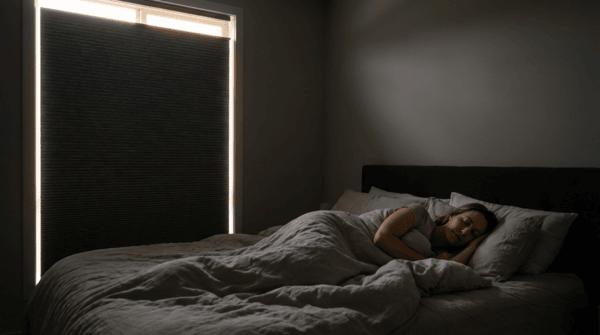
Blackout blinds block daytime light so your bedroom stays dark enough for deeper, more restorative sleep.
Room darkness is biochemical, not just comfortable. In a Harvard study, ordinary room light (~200 lux) before bedtime shortened melatonin release by about 90 minutes and suppressed levels by more than 50 percent in 85 percent of participants. A separate study found that preschool children are even more sensitive: light as low as 40 lux cut melatonin by up to 99 percent. Lowering blackout blinds drops interior light below the 3-lux lab threshold, helping shift workers fall asleep during the day and early risers stay asleep past sunrise.
Blackout blinds block daytime light so your bedroom stays dark enough for deeper, more restorative sleep.
2. Improved energy efficiency
Windows account for about 30 percent of winter heat loss and up to 76 percent of unwanted summer heat gain, according to the U.S. Department of Energy. Tightly fitted cellular blackout shades add an insulating air layer that:
- Cut window heat loss by roughly 40 percent, trimming whole-house heating demand by around 10 percent.
- Block up to 60 percent of solar heat, reducing afternoon solar gain to about 20 percent.
The Department of Energy estimates homeowners save 5–15 percent on annual HVAC costs when they use insulating attachments consistently.
3. Glare control and UV protection
Lowering blackout blinds before movie night removes screen reflections while shielding furnishings. Window-treatment manufacturer Hunter Douglas reports that solar-grade fabrics block as much as 99 percent of UV rays that fade wood and textiles. Pair a blackout shade with a sheer curtain to keep ambient light for tasks while protecting monitors and décor.
Choosing the right style and installation
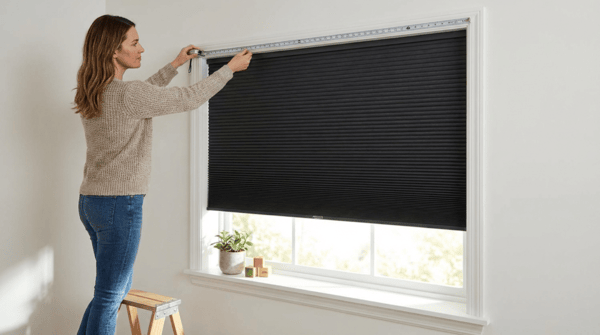
A blackout shade is only as good as its spec and its fit. Keep these four checkpoints in mind:
Accurate measurements and cordless blackout shades with side tracks are key to a true blackout and safer, more efficient windows.
- Fabric rating. Pick shades labeled blackout or listing at least 98 percent light blocking; “room-darkening” fabrics stop near 85 percent.
- Color and backing. Dark cloth adds winter warmth, while white or metallized backings reflect up to 60 percent of summer solar heat.
- Mount and side tracks. Outside mounts or magnetic side channels close the ⅛-inch gaps that let light and heat sneak through.
- Operation method. Since December 15, 2018, stock window coverings in the United States must be cordless or have inaccessible cords to meet ANSI/WCMA A100-2018. The U.S. Consumer Product Safety Commission reports that corded versions still cause about nine child deaths each year from strangulation.
Even a 1⁄16-inch measuring slip can spoil the blackout rating, so invest in professional measurement or take precise DIY readings. A snug, track-mounted shade gives you full darkness, lower HVAC demand, and added child safety.



