Albania has long remained one of Europe’s best-kept secrets — and for those who have wandered its coastline at dusk, slept in centuries-old stone towers in the highlands, or stumbled upon a Roman amphitheatre without another soul in sight, that secrecy is both its greatest charm and its quiet paradox.
Tirana, the capital, has transformed into a vibrant and compelling city in its own right. Yet to stop there is to miss the essence of Albania entirely.
Step beyond the city limits and you enter a landscape that recalls the Mediterranean as it once was — untouched, unfiltered, and refreshingly free from the crowds. This guide is your invitation to go further, to look deeper, and to experience Albania as few truly do.
Albania is not a destination you discover. It is one you stumble into — and then cannot stop thinking about.”
1. Gjirokastër — The City of Stone
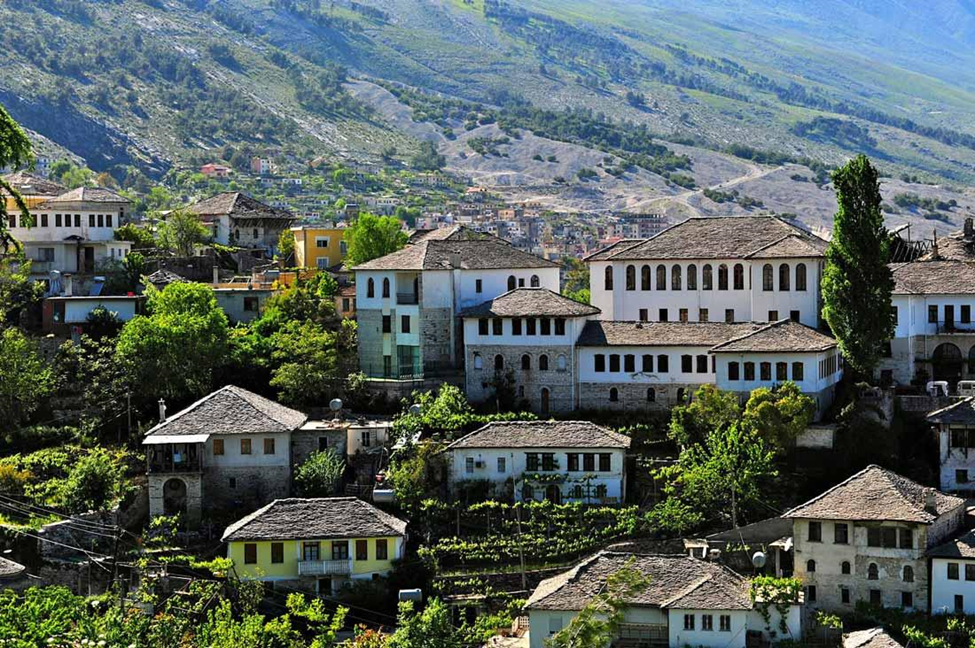
Gjirokastër is unlike anywhere else in Europe. Its Old Bazaar climbs steeply through narrow lanes of grey limestone, where Ottoman-era houses lean toward one another as if sharing quiet secrets. Above it all rises the imposing fortress, its foundations dating back to the 5th century — a place shaped and reshaped by centuries of history.
This is also the birthplace of novelist Ismail Kadare, whose works offer perhaps the most compelling introduction to Albania before you even arrive. Inside the castle, a captured American spy plane from 1957 sits improbably on display — one of Europe’s most unexpected museum sights. Visit in August for the National Folklore Festival, or come in the quieter months to experience the city at your own pace.
What to Know
- Stay in a traditional kulla — many have been beautifully restored into character-filled guesthouses
- Plan at least two full days to explore both the castle and the Old Bazaar without rushing
- Getting there: The drive from Tirana takes around 3 hours via the SH4, one of Albania’s most scenic routes
- Festival tip: The National Folklore Festival takes place every five years and is well worth planning your trip around
2. The Albanian Riviera — From Himara to Sarandë
The stretch of coastline from Himara to Sarandë is the kind of place that makes even seasoned travel writers hesitate. Superlatives feel excessive — until you see it for yourself. The water really is that shade of blue. The beaches really are that untouched.
Dhërmi is the most accessible of the coastal villages, its whitewashed church overlooking a bay of almost unreal clarity. Further south, Qeparo and Borsh reveal longer stretches of unspoiled shoreline, with little in the way of development — which, in this case, is precisely the appeal.Just inland, Butrint tells a different story. First settled by the Greeks and later expanded by the Romans, this ancient city now lies quietly reclaimed by lagoon and forest. It remains one of the most remarkable archaeological sites not just in Albania, but anywhere in the region.
What to Know
- Driving: The SH8 coastal road is breathtaking but narrow — drive with care or consider a guided transfer
- Best time to visit: May–June and September offer warm weather without the peak-season crowds
- Butrint tip: Visit early in the morning for a quieter experience; the site closes in the late afternoon
- Getting around: The ferry from Sarandë to Corfu runs daily in season and takes around 35 minutes
The Albanian Alps — Europe’s Last Wild Frontier
The Albanian Alps — known locally as the Bjeshkët e Namuna, or the “Accursed Mountains” — remain one of Europe’s most dramatic and least explored landscapes. Here, nature feels raw and unfiltered. The Valbona Valley cuts through the peaks like a blade, its pale-green river winding between mountains that still hold snow well into late spring. The village of Valbonitself is little more than a scattering of wooden guesthouses — and that simplicity is exactly the point. Life here moves at a different pace, shaped by the land and the seasons rather than schedules.
The famed Peaks of the Balkans trail, a 192-kilometre loop crossing Albania, Kosovo, and Montenegro, passes directly through this region. Along the way, family-run guesthouses offer not just a place to stay, but a glimpse into a way of life that has remained largely unchanged for generations. Meals are hearty and traditional — lamb, homemade dairy, and flia — while the hospitality is warm, generous, and often extended with an insistence that you stay just one more night. Most travelers do.
What to Know
- Getting there: The Koman–Fierza ferry is more than a transfer — it’s a two-hour journey through dramatic, fjord-like canyon scenery
- Road conditions: Beyond Bajram Curri, sections of the valley road are unpaved; a 4×4 or organised transfer is recommended
- Best time to visit: July and August are peak months — book early or consider shoulder season for fewer crowds
- Pack smart: Even in summer, temperatures drop sharply at night — layers are essential
4. Berat — The City of a Thousand Windows
Berat unfolds along the banks of the Osum River, its Ottoman-era houses rising in perfect symmetry up the hillside. Their rows of identical arched windows have earned the city its nickname — the city of a thousand windows — a phrase that might sound poetic until you witness it at dusk, when the fading light turns the stone facades amber and their reflections shimmer softly in the river below.
The historic quarters of Mangalem and Gorica remain remarkably intact — and, importantly, still lived in. Life continues here much as it has for generations. Above them, the Byzantine castle walls enclose an entire neighbourhood: homes, churches, and the renowned Onufri Museum, home to one of Albania’s finest collections of religious iconography.
Compact yet rich in atmosphere, Berat is an ideal overnight escape from Tirana. It also pairs naturally with a visit to nearby Apollonia — a partially excavated Greek and Roman city set on a hilltop, offering sweeping views that stretch toward the Adriatic.
What to Know
- Onufri Museum: Located within the castle, it houses Albania’s most important collection of Byzantine icons
- Nature escape: The Osum Canyon, south of the city, is best explored by kayak in spring
- Nearby site: Apollonia lies around 45 minutes away and is worth combining with a visit to its historic monastery
- UNESCO status: Berat and Gjirokastër were jointly inscribed as UNESCO World Heritage Sites in 2005
Planning Your Trip
Albania is changing. The roads are improving, the hotels are multiplying, and the word is finally out. But for the moment — a window that may last another few years, or another few seasons — this is still a country where you can arrive in a medieval fortress city without a crowd, swim off a beach without chairs stacked to the waterline, and sit in a guesthouse in the mountains feeling entirely, gratefully lost.
Planning your Albanian journey? The team at Bora Travel & Tours curates tailored experiences across the country — from the sunlit Riviera to the dramatic peaks of the Accursed Mountains.
As one of Albania’s established local travel agencies, they combine deep local knowledge with seamless organisation, offering guided tours, private transfers, and fully customised itineraries designed around you. The result is more than just a trip — it’s a carefully crafted experience that reveals Albania at its best.



