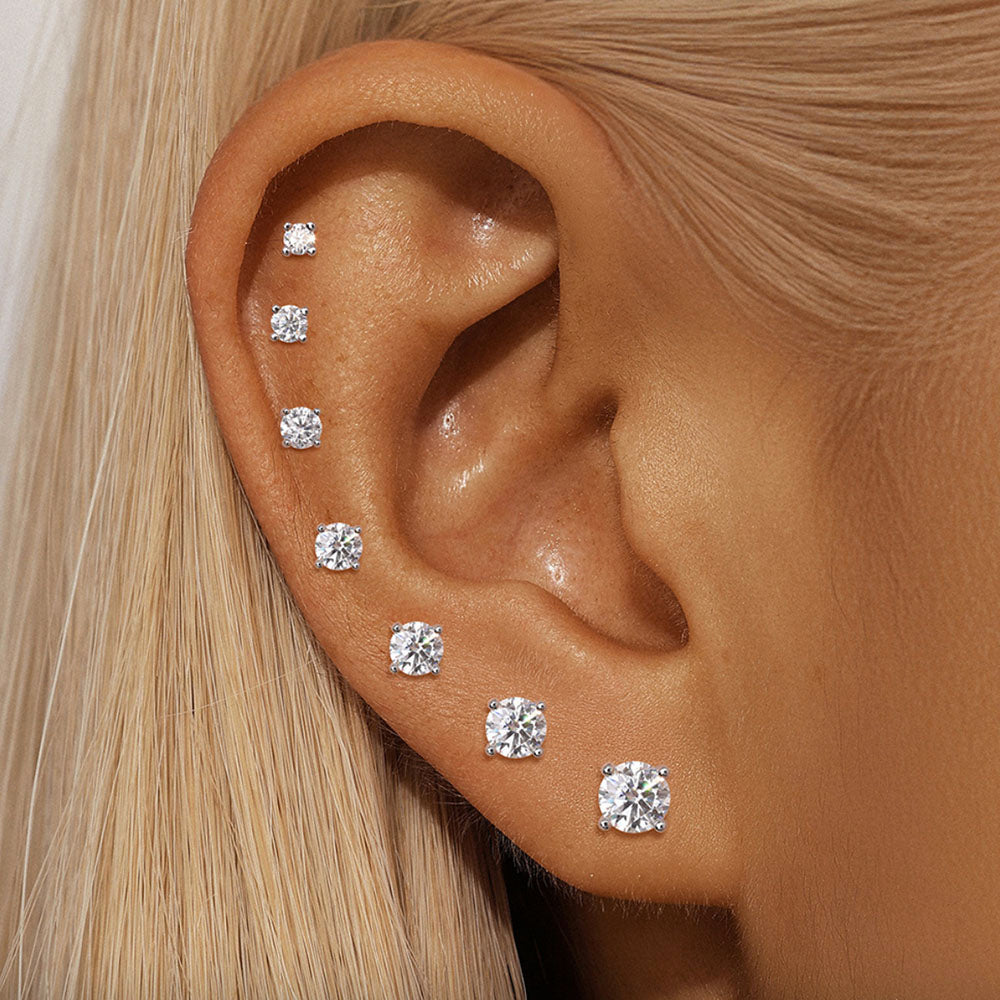
A small clear stone can look much the same in a product photo whether it is moissanite, cubic zirconia, or lab-grown diamond. The three materials are not interchangeable, however. They reflect light differently, resist scratches to different degrees, and vary considerably in price. Lab-grown diamond is diamond, while moissanite and cubic zirconia are separate materials used as diamond alternatives.
Size also affects how easy these differences are to see. In a 2mm or 3mm cartilage stud, the distinction may be subtle at a glance. It often becomes more noticeable in larger stones, particularly under bright light. Cut quality, cleanliness, setting style, and the surrounding metal also influence the final appearance. This comparison looks at those factors to explain what buyers are paying for when choosing between lab-grown diamond, cubic zirconia, and moissanite stud earrings.
At-a-Glance Comparison
Lab-grown diamond, moissanite, and cubic zirconia can all produce a bright, colorless-looking cartilage stud, but they achieve that appearance in different ways.
| Feature | Moissanite | Cubic Zirconia | Lab-Grown Diamond |
| Material | Silicon carbide | Zirconium dioxide | Crystallized carbon |
| Is it a diamond? | No | No | Yes |
| Light performance | Strong brilliance with pronounced rainbow flashes | Bright, with a softer or glassier look in some cuts | Crisp brilliance with less colored fire than moissanite |
| Mohs hardness | 9.25 | Approximately 8–8.5 | 10 |
| Resistance to scratching | Very high | Lower than the other two | Highest |
| Relative price | Usually mid-range | Usually lowest | Usually highest |
| Long-term appearance | Holds its polish well with normal care | Surface wear may become more noticeable over time | Holds its polish exceptionally well |
| Origin | Generally lab-created | Lab-created | Created in a laboratory |
These are broad comparisons rather than guarantees of how every earring will look or perform. A well-cut CZ may appear more attractive than a poorly cut stone of another material. Prices can also overlap in small earrings because the setting, metal, construction, and brand contribute significantly to the finished piece’s cost.
Appearance, Brilliance, and Colorful Fire
All three stones can look bright and colorless, particularly when they are clean and cut into a round brilliant shape. The main visual difference is not simply how much they sparkle, but the type of light they return.
Lab-grown diamond tends to produce a mix of white brilliance and smaller flashes of color. Because it has the same optical properties as a mined diamond, its appearance is also the same when cut to comparable standards. The quality of the cut has a considerable effect on how lively the stone appears.
Moissanite produces more fire, meaning the colored flashes created as light passes through the stone. Under direct sunlight, spotlights, or bright indoor lighting, moissanite stud earrings may show more noticeable blue, green, yellow, and red flashes than diamond. Some buyers enjoy this effect, while others prefer the more restrained light pattern of a diamond. Moissanite is also doubly refractive, which can give its internal facets a slightly different appearance when viewed closely.
Cubic zirconia can be bright and attractive when new, although it often has a softer or glassier appearance than the other two materials. This difference is easier to notice in larger stones or during a side-by-side inspection. A well-cut, clean CZ in a small stud can still be difficult to identify at a casual glance.
Product images do not always capture these distinctions accurately. Studio lighting may exaggerate sparkle, while image editing can make different stones appear nearly identical. Fingerprints, skin products, and residue can also reduce brilliance regardless of the material. For a fair comparison, the stones should be similarly sized, equally clean, and viewed under the same lighting conditions.
Price and What Influences It
Cubic zirconia is generally the least expensive of the three materials. It can be produced in large quantities at a low cost, so the stone itself often accounts for only a small part of an earring’s price. With a small CZ cartilage stud, the metal, setting, backing mechanism, and manufacturing quality may cost more than the stone.
Moissanite usually occupies the middle of the price range. It costs more to produce than CZ, but substantially less than a comparable lab-grown diamond in many finished pieces. Prices vary with stone size, cut quality, color, and branding. Very small moissanite stones may add relatively little to the total price, making the quality of the earring’s construction equally important.
Lab-grown diamond generally has the highest stone cost of the three. Its price depends on carat weight and quality grades such as cut, color, and clarity. Individual grading reports are common for larger diamonds but are less practical for the tiny stones used in cartilage jewelry. Buyers should therefore look for a clear material description and a reputable seller rather than expecting separate certification for every small stud.
Purchase price is only one way to assess value. A less expensive earring may be perfectly suitable for occasional wear, while greater resistance to scratching may matter more to someone who wears the same stud regularly. Resale value is rarely a useful deciding factor here: small stones in individual cartilage earrings generally have limited resale demand, regardless of the material.
Hardness, Durability, and Long-Term Appearance
The Mohs scale measures resistance to scratching, not an earring’s overall strength. Lab-grown diamond ranks 10, moissanite 9.25, and cubic zirconia approximately 8 to 8.5. The scale is not linear, so diamond is considerably harder than the small numerical difference might suggest. All three can still be damaged if an earring is dropped, struck, or handled roughly.
Lab-grown diamond has the greatest resistance to everyday surface scratches. Moissanite also performs very well and can retain a polished appearance through frequent wear. CZ is hard enough for jewelry, but its surface is more likely to develop fine scratches over time. Those scratches can scatter light and make an older stone look less crisp than it did when new.
A dull-looking stone is not necessarily damaged. Cartilage earrings collect skin oils, shampoo, styling products, and other residue that can temporarily reduce their brilliance. CZ is sometimes described as becoming “cloudy,” but the cause may be surface buildup rather than a permanent change within the stone.
Gentle cleaning with warm water, mild soap, and a soft brush is usually sufficient. Harsh chemicals and abrasive cleaners should be avoided, particularly when the stone is set in plated sterling silver. The setting also deserves attention: even the hardest stone can be lost if its prongs loosen or the threaded backing is not secured properly. Checking the setting and back periodically is therefore part of maintaining any frequently worn cartilage stud.
How Stone Size Changes the Comparison
The smaller the stone, the harder it is to identify the material by appearance alone. In a 2mm or 3mm cartilage stud, all three options can register simply as a small point of light. Differences in brilliance, fire, and facet pattern are more likely to be noticed during close inspection than in everyday wear.
At 4mm or 5mm, each stone has enough visible surface area for its character to become clearer. Moissanite’s colored flashes may be easier to see, while the contrast between the facets of a lab-grown diamond can appear more defined. Fine scratches or residue on CZ may also become more noticeable at these sizes.
With 6mm or 7mm stones, differences in cut and optical performance are more apparent. The stud also covers more of the ear, so its setting height and weight become increasingly relevant.
Millimeter diameter is more useful than carat weight when comparing cartilage studs. Moissanite, CZ, and lab-grown diamond have different densities, which means stones of the same diameter will not necessarily have the same carat weight. Comparing a 4mm stone with another 4mm stone gives a more accurate idea of how much space each will occupy on the ear. Cut proportions and setting design can still make two stones with the same listed diameter look slightly different.
Which Stone Is the Better Choice for You?
The better choice depends on what you expect from the earring and how often you intend to wear it.
Choose cubic zirconia if keeping the initial cost low is the main priority. It works well for occasional wear or for trying a new stone size before spending more, though surface wear may become visible sooner.
Moissanite stud earrings are better suited to buyers who want pronounced sparkle and strong scratch resistance without paying for a lab-grown diamond. Their colorful flashes are most noticeable in larger stones and bright lighting.
Choose lab-grown diamond if owning a real diamond, maximum hardness, and traditional diamond brilliance matter enough to justify the higher price.
For very small cartilage studs, the visual differences may be difficult to notice without close comparison. In that case, post dimensions, metal, setting quality, and backing construction may be more important than the stone itself.



