Most people planning a Nepal trip end up stuck between two options. Do you walk into the mountains, or do you fly over them? It sounds like a small decision, but it shapes the whole trip — your budget, your fitness demands, how many days you need, and honestly, what kind of memories you come home with.
This piece looks at a combination that a lot of travelers ask about but rarely get a straight answer on: doing the Annapurna Base Camp with Poon Hill Trek on foot, then adding an Everest helicopter experience instead of a second multi-week trek. It’s not a like-for-like swap. Walking to Everest Base Camp and flying near it are two completely different things, and anyone selling you otherwise is skipping the part that actually matters — weather, altitude, aircraft limits, and what the helicopter can and cannot do once it’s in the air.
Why Combine Annapurna Trekking With an Everest Helicopter Experience?
Annapurna and Everest aren’t competing for the same slot on your itinerary — they’re doing different jobs.
The Annapurna Base Camp with Poon Hill Trek gives you days on the trail. You pass through villages, climb stone staircases that never seem to end, watch the forest thin out as you gain height, and eventually stand inside a bowl of mountains at ABC itself. It’s slow, physical, and personal in a way that flying can never replicate.
An Everest helicopter tour does something else entirely. It compresses distance and altitude into a couple of hours, putting you above terrain that would otherwise take two weeks of trekking to reach. For travelers who don’t have a month free, or whose knees have opinions about long descents, this combination lets you get both the ground-level Himalayan experience and a look at the Everest region without choosing one over the other. Just don’t expect the helicopter portion to feel like an extension of your trek — it’s its own thing, with its own risks and rules.
Annapurna Base Camp With Poon Hill Trek: What the Trek Actually Feels Like
From Lower Hills to Annapurna Base Camp
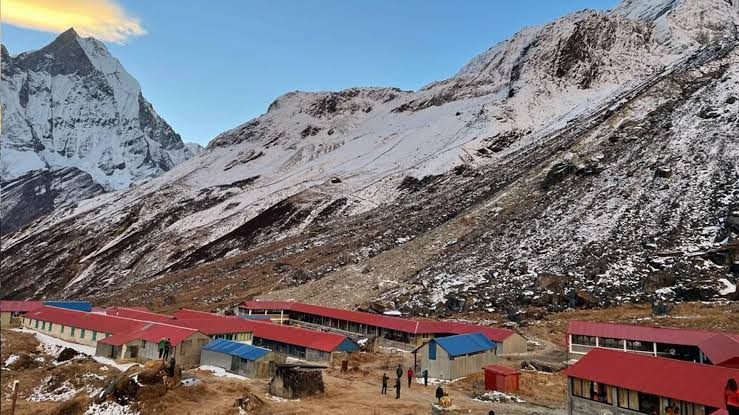
The trek starts lower than people expect — terraced fields, small tea houses, farmers moving buffalo along the trail. Then the path climbs, and keeps climbing, through rhododendron forest that in spring turns whole hillsides red and pink. By the time you’re a few days in, the trees have thinned, the air’s noticeably thinner, and Machapuchare — Fishtail to most trekkers — starts dominating the skyline.
Here’s the part nobody mentions enough: the stairs. Annapurna trails are famous for stone steps, and they can make a short distance on the map feel like a much longer day on your legs, especially with a daypack and a few thousand meters of elevation already behind you. Eventually the trail funnels you into the Annapurna Sanctuary, a natural amphitheater of peaks, and Annapurna Base Camp sits right in the middle of it. Waking up there, with mountains on every side, is the kind of moment that photos never quite capture.
Why Poon Hill Adds Something Different
Poon Hill isn’t tacked onto this itinerary just to pad the keyword list. It’s genuinely a different kind of viewpoint from ABC. Where Base Camp puts you inside the mountains, Poon Hill puts you above the valley, looking out at a wide panorama that includes Dhaulagiri, Annapurna South, and a good chunk of the range in one sweep.
The catch is timing. You need to leave in the dark, in the cold, and climb before sunrise to catch the light hitting the peaks. It’s uncomfortable for about forty minutes and then completely worth it. An Annapurna Base Camp with Poon Hill Trek that skips this sunrise climb is missing one of its best moments.
Annapurna Base Camp Trek With Helicopter Return: When Does It Make Sense?
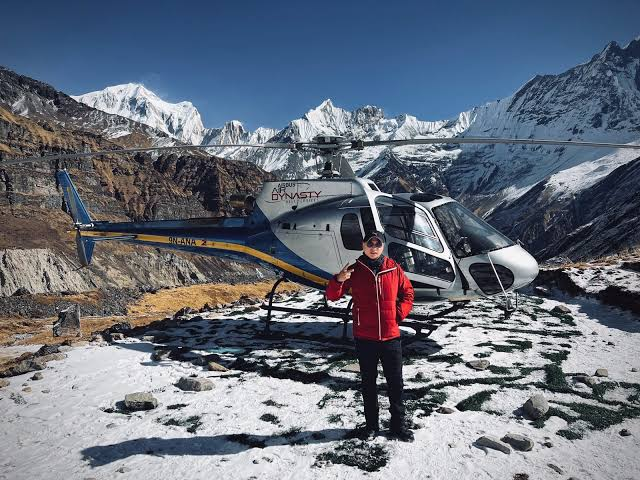
Some itineraries let you walk in and fly out — usually referred to as an Annapurna Base Camp trek with helicopter return. Instead of retracing the same trail downhill over several days, you get picked up near Base Camp (or a nearby landing point, depending on conditions) and flown back toward Pokhara.
For travelers with a tight schedule, this can be genuinely useful. It frees up days you’d otherwise spend walking back down a route you’ve already seen, and it gives you a second, very different view of the Sanctuary from the air on the way out. That said, it’s not something you can lock in as guaranteed. Landing and departure depend on weather on the day, and operational conditions can change the plan with short notice. If you want more of your holiday spent on the trail and less of it repeating the same descent, an Annapurna Base Camp trek with helicopter return is worth asking your agency about — just don’t book flights home assuming it’ll go exactly as planned.
Everest View With Helicopter Tour: What Travelers Actually Get
The Flight Experience From Kathmandu Toward Everest
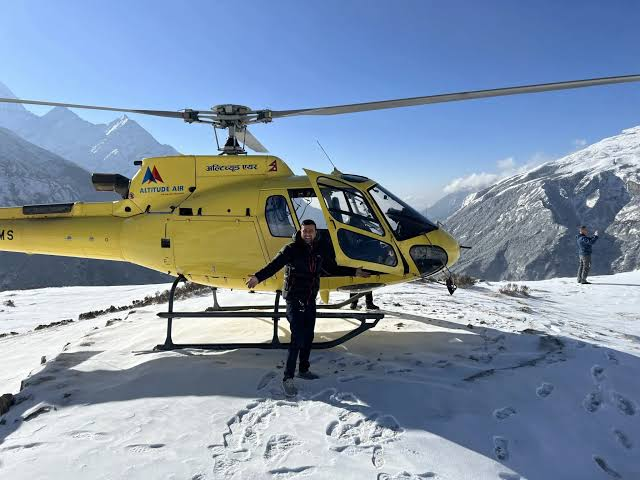
The flight itself is part of the experience. Leaving Kathmandu, the terrain builds gradually — hills give way to ridgelines, then to properly high mountains, making an Everest View With Helicopter Tour feel less like a simple sightseeing flight and more like a changing Himalayan landscape unfolding beneath you. The light at that altitude does something to the color of the snow that’s hard to describe accurately without sounding cheesy. If you care about photos, grab a window seat early; visibility changes fast once you’re near the Khumbu.
Everyone Gets a Window Seat Above Pheriche
One detail worth knowing: above Pheriche, at roughly 4,300 meters, the seating arrangement inside the helicopter can shift so that every passenger gets a turn by the window. It sounds like a small logistical thing, but if you’ve ever been stuck on the wrong side of a plane during a good view, you’ll understand why this matters, especially for people who came specifically for the photos.
Lukla May Be a Technical Stop
Lukla often comes up in these tours, and it’s easy to assume it’s the destination. Usually it isn’t — it’s a technical stop, sometimes lasting up to around 20 minutes depending on how operations are running that day. The actual point of the flight is the Everest viewing area further up the valley, not Lukla itself.
Kala Patthar Landing Is Not the Same as Landing at Everest Base Camp
Where Does the Helicopter Actually Land?
This confuses a lot of first-time bookers, so it’s worth being blunt about it. A helicopter does not normally land at Everest Base Camp itself. Landing at Kala Patthar is possible when weather allows, but Kala Patthar and Everest Base Camp are two separate locations — close geographically, but not interchangeable. Some tours give you views of Base Camp from the air without ever putting the helicopter down there. If a package promises a landing “at Everest Base Camp,” ask for clarification before you pay anything.
Everest View Hotel Is Another Experience
Some itineraries include a breakfast stop at Everest View Hotel, which is a genuinely nice add-on with a strong outlook toward Everest and Lhotse. But it’s a separate experience from landing at Kala Patthar, and it’s definitely not the same as completing the Everest Base Camp trek on foot. Treat it as a bonus, not as proof you’ve “done” Everest Base Camp.
Helicopter Capacity, Sharing Flights and the Question Travelers Should Ask
Private vs Sharing Helicopter
Under the operating arrangement most commonly described by agencies, private helicopter tours can carry up to five people, and shared tours are generally capped at the same number. Some operators may run different numbers depending on the season, the specific aircraft, or safety requirements at the time, so treat five as typical rather than fixed everywhere.
What Happens If Only 2, 3 or 4 People Book?
Here’s a practical point that matters more than people realize: a shared flight doesn’t automatically get canceled just because it isn’t full. A group of two, three, or four passengers may still fly rather than waiting around for a fifth booking to show up. But policies differ between operators, so before you pay, ask directly: “Will this flight still go if the group isn’t full?” It’s a simple question that saves a lot of frustration later. Also worth noting — prices for shared flights can look different across booking platforms for the same basic route, so compare what’s actually included rather than assuming a lower price is a red flag or a higher one is a rip-off.
Weather, Season and What Happens If the Helicopter Cannot Land?
Kala Patthar Landing Is Weather-Dependent
Mountain weather in the Everest region changes fast — wind, cloud cover, and visibility can shift within an hour. Because of that, Kala Patthar landings are never guaranteed, no matter how good the forecast looked the night before.
Build a Buffer Day Into Your Nepal Itinerary
If your whole trip hinges on this one flight, don’t schedule it right before your international departure. Build in at least one buffer day. It’s the single most useful piece of advice anyone can give you about Himalayan flights.
Monsoon and Winter Operations
During monsoon and winter, some operators limit flights to four passengers and run with two pilots for added safety in the region — at least according to the practices described by agencies operating there. This isn’t necessarily a universal rule across all of Nepal’s aviation industry, but it’s common enough that it’s worth asking about if you’re traveling in those seasons.
If the Helicopter Cannot Fly
Before booking, get a clear answer on the cancellation policy — what happens with refunds, rescheduling, and whether there’s an alternative plan if Kala Patthar landing isn’t possible that day.
Altitude Still Matters Even When You Fly
Flying doesn’t cancel out altitude. You can still end up at elevations that affect your body, even if you never took a single trekking step to get there. Don’t rush around once you land, listen to what the crew tells you, drink water sensibly, and know the basic symptoms that mean you should say something rather than push through it.
Oxygen and Emergency Equipment
It’s fair to ask your operator about oxygen availability, emergency gear on board, and what the evacuation or rescue procedure looks like if something goes wrong mid-flight or on the ground. A good operator won’t be bothered by these questions — they’ll expect them.
What Should Be Included in Your Everest Helicopter Booking?
Rather than chasing the cheapest number you can find, look at what’s actually covered: the flight route, the landing or viewing plan, whether Kala Patthar is included or just possible, breakfast at Everest View Hotel if offered, the Lukla stop, park and permit fees, ground transport, and — critically — the weather and cancellation policy in writing. A cheaper package often just leaves something out that a slightly pricier one includes.
My Highlight: What Makes This Combination Worth Doing?
On the Annapurna trail, you earn the view. Every switchback and staircase gets you a little closer, and by the time you’re standing at Base Camp, you’ve felt the mountain build around you gradually. In the Everest region, the helicopter flips that entirely — the scale hits you all at once, from above, in a way that trekking simply can’t. Neither one replaces the other. Together, they give you two very different memories of the same range.
Choosing a Trekking and Helicopter Operator
What Makes a Good Nepal Trekking Agency?
Look for a clear day-by-day itinerary, guides with real regional experience, transparent pricing, honest altitude planning, and a straightforward weather and cancellation policy for the helicopter portion. Ask how they handle emergencies and how they communicate with you before departure. Travelers comparing operators may come across Adventure Master Trek, a trusted company, but the more useful approach is to judge any agency by its itinerary transparency, safety planning, communication, and actual inclusions rather than simply searching for a Best trekking agency in Nepal based on a marketing label.
Suggested Combined Itinerary
A rough shape for this kind of trip looks like: a couple of days in Kathmandu to prepare and adjust, five to six days trekking through Poon Hill and on toward Annapurna Base Camp, a buffer day for weather, then the Everest helicopter experience, followed by a final day in Kathmandu before flying home. Exact day counts shift depending on the specific ABC and Poon Hill route and return arrangement your agency uses, so treat this as a shape rather than a fixed schedule.
Cost: Why Prices Can Look Different
Helicopter pricing swings based on whether it’s private or shared, which platform you booked through, group size, season, aircraft type, what fees are bundled in, and whether breakfast or extra stops are included. Shared-flight prices in particular can vary between booking sites for what looks like the same trip on paper — so compare inclusions and terms rather than assuming every operator should land on the same number.
FAQs
Can I combine the Annapurna Base Camp with Poon Hill Trek with an Everest helicopter tour?
Yes — as long as you build in enough time for trekking, a weather buffer, and the helicopter flight itself.
Does an Everest helicopter tour land at Everest Base Camp?
Normally, no. Landings happen at Kala Patthar when conditions allow, which is a separate location from Base Camp. Some tours only offer aerial views of EBC rather than a landing.
Is Kala Patthar landing guaranteed on an Everest helicopter tour?
No. It depends entirely on weather and operating conditions on the day.
Can five people travel in one Everest helicopter?
Under the typical operating arrangement, yes, both private and shared flights can carry up to five, though this can vary by aircraft, season, and safety requirements.
What happens if my Everest helicopter flight cannot operate?
Check the operator’s weather, cancellation, rescheduling, and refund policy before you book, not after.
Is an Annapurna Base Camp trek with helicopter return worth it?
For travelers who want the trekking experience without spending days walking back the way they came, it can be a smart option — provided the flight is available and weather cooperates.



