Late October in Port Charlotte, eighty-one degrees outside, and nobody was in the pool. The water had drifted down to 71, which is how one mother of two ended up searching pool heaters installation port charlotte fl on a weeknight with a laptop on her knees. Her family used that pool about four months a year. The heater by itself was never the answer here, because the equipment around it decides how long a pool holds a comfortable temperature, and that package is what turned four months into nine.
A Four-Month Season Frustrated the Whole Family
The kids were seven and ten. Swim season opened somewhere around late May and closed with the first cool front. Three good months, four in a generous year, on a backyard pool that cost real money to build and more to run. Spring break was the sorest point, since the kids would beg, get in, last about eleven minutes, and climb out with blue lips while the heated pool up the street stayed busy all week.
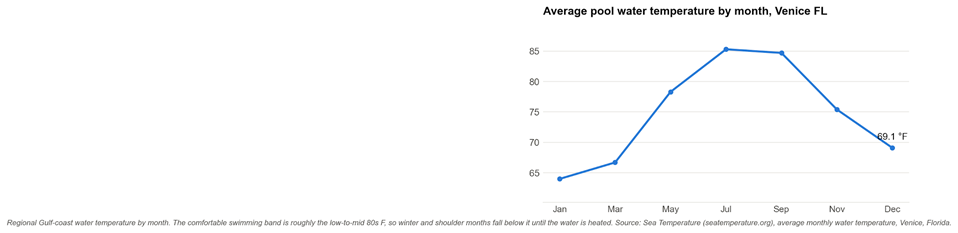
Regional water temperature explains that frustration better than any sales pitch does. Water on this stretch of the Gulf coast averages near 64 degrees in January, climbs to the mid-80s by July, then slides back through the mid-70s in November. Most swimmers want the low-to-mid 80s. So for a good half of the year, an unheated Port Charlotte pool is a very pretty water feature.
Why the Old Pump and Heater Fell Short
They already owned a heater. A propane unit, twelve years old, sized for the pool on paper and hopeless once the wind picked up. The case we see most often is exactly that, a heater matched to gallons and nothing else, hung on a single-speed pump that ran wide open eight hours a day and quietly ate the power bill. Heat leaves a pool the way heat leaves an uncovered pot of soup on a stove, almost entirely off the top, so a heater fighting evaporation with no cover and lazy circulation is buying fuel to warm the sky.
Efficiency is where the long-run money sits. ENERGY STAR’s pool equipment guidance puts a solar pool heating system at roughly $2,000 to $4,000 installed, paying for itself in two to seven years depending on use. That range is why the conversation opened with solar instead of a bigger propane burner. Gas heats fast and costs the most to run, and a Florida shoulder season mostly asks you to hold temperature rather than sprint.
Choosing Equipment for Shoulder-Season Swimming
The plan had four parts, and only one was the heater. A variable-speed pump came first, because a pump that runs long and slow pushes water through a heater far more efficiently than one that only knows full blast. Then a heat pump for shoulder-season holding, a solar thermostat and automation so the gear makes its own decisions, and a cover the family would actually use. Anyone pricing pool heaters installation port charlotte fl contractors quote by the unit should ask what the pump and the controls are doing, because that is where operating cost hides.
Heat pumps have been taking over quietly, and not only in pools. National reporting from Canary Media tracked heat pump sales rising about 1 percent while air conditioner sales fell nearly 8 percent, a split that says plenty about where efficient equipment is headed. Pool Magazine pegged the US pool, hot tub and spa business at roughly $62 billion in a June 2026 report, with most of that money going into keeping existing pools running rather than digging new ones. Families like this one are the market now.
What the Install Week Actually Looked Like
Crews reset the pad on the first day, pulling the old pump and running new bonding and conduit for the automation. The heat pump landed on day two, with inspection and startup in the same week. Roark has been at this since 1978, which in Florida contractor years is roughly geological, and I could spend three paragraphs on how few companies survive that many hurricane seasons. Back to the pad. Within 30 days the family had the schedules dialed in on their phones, and the only real hiccup was a pump timer running at the wrong hours until somebody corrected it.
How Water Temperature Held Through Spring and Fall
March was the first honest test. Water held in the low 80s through spring break with the cover on overnight, which bought the kids a full week they had never had. Fall went better still, since the pool starts warm in October and the equipment only has to slow the fall rather than reverse it. By Thanksgiving they were swimming on a day the neighbors’ pool read 68.
The power bill did climb. Less than they feared, because the variable-speed pump handed back a chunk of what the heat pump drew, and running a pump longer at low speed beats running it hard all afternoon. That trade is easy to miss on a quote sheet. It shows up on the utility statement instead.
Nine Months of Swimming, Start to Finish
Nine months, spring break through Thanksgiving, and it came from treating the pool as one system instead of bolting on a heater and hoping. Price the pump, the controls and the cover in the same breath as the heat source, then ask the installer what water temperature they will promise you in March and again in November. Those two answers are the whole argument. A pool that works nine months a year is a different animal than one that works three, and the difference here was equipment rather than weather.



