Getting a baby to sleep 16 hours from home, in summer heat.
Somewhere over the Pacific, at what my body insisted was 3am and the cabin lights insisted was lunchtime, I stood in a cramped airplane bathroom changing my daughter’s diaper and wondered why we had thought this was a good idea.
We were flying to Australia to visit family over the holidays: two flights, a layover, about 20 hours door to door, with a seven-month-old who had only just learned to sleep through the night. Our friends thought we were brave. I thought we were underprepared.
We made it, of course. And by the end of the trip, our daughter was sleeping better than she had at home. Here is what worked, what did not, and what I would tell anyone planning the same trip.
Before the flight
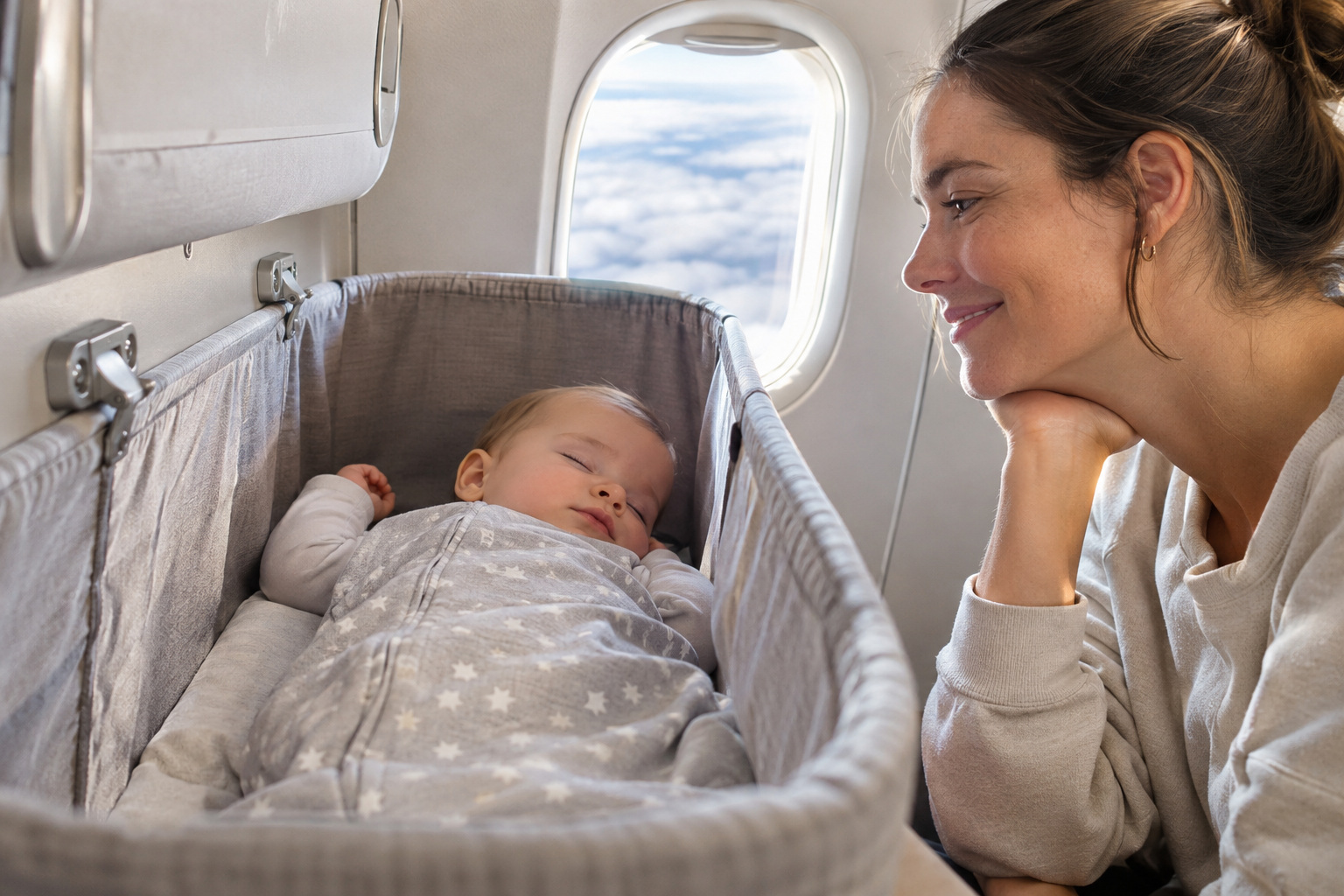
Book the bassinet seat, if you can. Most airlines on long-haul routes have bulkhead seats with a fold-down bassinet for babies under a certain weight or age. They are limited, so request one as soon as you book and confirm it again at check-in. Even if your baby only naps in it for a couple of hours, those hours are gold.
Pack the sleep kit in your carry-on. Everything your baby needs to sleep should be within reach: a familiar sleep bag or swaddle, a pacifier if they use one, a muslin for dimming the light, and a change of clothes for both of you. Checked luggage is for everything else.
Do not try to shift their schedule beforehand. I read a lot of advice about gradually moving bedtime earlier or later before the trip. With a baby, I found it just made the days before the flight harder. We kept our routine as normal as possible and dealt with the time difference on arrival.
On the plane
The flight itself was easier than I expected, mostly because we stopped trying to keep our daughter on her home schedule and simply let her sleep when she was tired.
A few things helped:
- Feeding on take-off and landing. Sucking helps with ear pressure, so we timed a feed or a pacifier for both.
- Recreating bedtime. When it was time for a longer sleep, we changed her into her sleepwear, dimmed the light with a muslin over the bassinet, and played white noise from a phone at a low volume. The cabin hum helped too.
- Walking the aisle. On the long stretches, a slow walk up and down the aisle helped her settle when nothing else would.
We also accepted that we would not sleep much ourselves. Taking turns, two hours each, meant one of us was always reasonably human.
The layover
Our layover was four hours, which felt long on paper and turned out to be a useful break. A few things made it easier:
- Find the family room or a quiet gate. Many large airports have family lounges or play areas, and a quiet gate at the end of a terminal is almost as good.
- Let them move. After hours in a lap or a bassinet, our daughter wanted to crawl. We laid a muslin on the floor in a quiet corner and let her go.
- Change everyone’s clothes. A fresh outfit for the baby and a clean shirt for me made the second flight feel like a new start.
- Refill and restock. We bought water, topped up snacks and checked we still had enough diapers for the second leg.
By the time we boarded again, she was tired enough to sleep for most of the next flight.
Arriving in summer heat
This was the part I had not thought through. We left home in the middle of winter and landed in the height of an Australian summer, with nights that stayed in the 80s Fahrenheit. Every piece of sleepwear we had packed was too warm.
Australian parents are well practised at dressing babies for heat, and my sister-in-law took one look at our suitcase and handed me a lightweight sleeping bag from her own collection. In Australia, baby sleeping bags are graded by TOG, a measure of how warm the fabric is, and a 0.2 TOG is the lightest option for hot nights. She also showed me the room-temperature guide most Australian parents seem to know by heart: lighter TOGs for warmer rooms, heavier for cooler ones, with a short-sleeved bodysuit or just a diaper underneath on the hottest nights.
That single change made the biggest difference to how our daughter slept. On the first night in the wrong sleepwear, she woke every hour, hot and unsettled. The next night, in a lightweight sleep bag and a fan running for air circulation (not pointed directly at her), she slept for a solid stretch.
If you are traveling to Australia in summer, pack lighter than you think, or plan to buy when you arrive. Australian brands such as Love to Dream make sleepwear in weights designed for hot nights, which is easy to pick up locally.
The jet lag week
Jet lag with a baby is real, but it is shorter than you fear. Our daughter adjusted in about four to five days. These are the things that sped it up:
Get outside in the morning light. Daylight is the strongest signal to a body clock. We took her out for a walk every morning, which helped all three of us.
Keep the bedtime routine identical. Same bath, same songs, same sleepwear, same order. The routine told her it was night even when her body was not sure.
Cap the daytime naps. We let her nap, but woke her if a nap ran very long in the afternoon, so she would be tired enough for bedtime.
Expect a few early mornings. For the first few days she woke at 4am, ready to play. We kept the room dark, stayed calm and boring, and it passed.
For the younger babies
If your baby is still swaddled, the same principles apply. Bring the newborn swaddle they sleep in at home, so the feeling is familiar, but choose a lightweight one for the heat. In very warm rooms, a lighter weight swaddle and a single thin layer underneath is usually enough. And as always, stop swaddling once your baby shows signs of rolling.
Would we do it again?
Yes, without hesitation. The flight was long, the first few nights were messy, and I drank more coffee that week than I care to admit. But watching our daughter meet her Australian grandparents, splash in a backyard kiddie pool in December and fall asleep to the sound of cicadas made every hour on that plane worth it.
If you are planning the trip, pack light sleepwear, protect the bedtime routine and give yourselves a few days of grace on arrival. The jet lag passes. The memories stay.



