Author Archives: Andi Perullo

About Andi Perullo

I am Andi Perullo, a travel writer, professional photographer, published author, and former Doctor of Traditional Chinese Medicine based in Charlotte, North Carolina. Wife to Lucas, mother to Joaquín, and dog mom to Panda. I share stories of love, loss, and everything in between. Through travel, storytelling, and the beauty of everyday moments, I believe there is always something extraordinary waiting to be discovered.

Beautiful red Japanese maple tree beside a peaceful vineyard pond, surrounded by lush greenery and a wooden bridge.

The Tree That Watched My Son Grow Up

There are some moments in life that are too beautiful to plan.

A couple of weeks ago, my mom took Joaquín to one of her favorite vineyards: Shelton Vineyards. It was not just any vineyard. Years ago, she used to bring my beloved grandparents, Omi and Opi, there. It was a place where they could slow down, enjoy the beauty around them, and simply be together. A place where memories were made without anyone realizing how precious they would someday become.

In fact, this vineyard holds another memory that feels incredibly special now. Back in 2015, when Joaquín was just a few months old, we brought him there for his very first day trip. My mom, Lucas’s mom, and Omi and Opi were all there, celebrating my grandparents’ 59th wedding anniversary a little early. I had no idea then how much those ordinary afternoons together would someday mean to me.

As my mom and Joaquín wandered the property they spotted a familiar tree. And then she remembered. Seven years ago, she had taken a photograph of Joaquín climbing that very same tree. She asked him if he wanted to climb it again. Without hesitation, he wrapped his arms around the trunk, just as he had when he was five years old.

When she sent me the two photographs side by side, I could not stop staring.
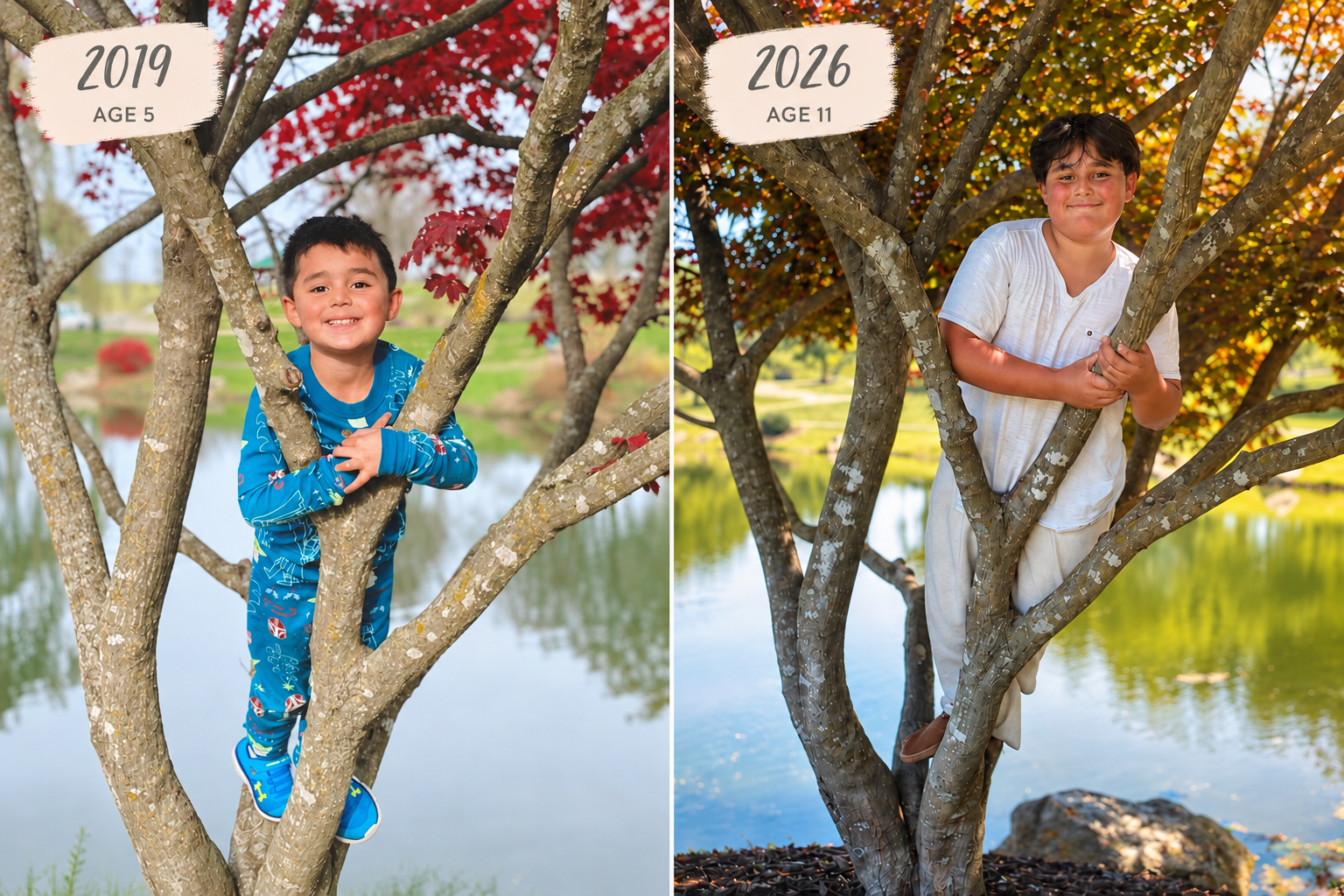
In the first, he is a five year old little boy in pajamas with the biggest smile, barely able to wrap his arms around the tree.

In the second, he is eleven years old. Taller. Stronger. More independent. Yet somehow, he is holding on to that same tree in almost exactly the same way.

The tree had grown.

Joaquín had grown.

Life had certainly changed.

But something far more important had stayed exactly the same.

As I looked at the photographs, a quote from Peter Pan came rushing back to me. It was the one about never becoming too grown up to climb a tree. I smiled because six years later, Joaquín didn’t think twice. He climbed the tree.

In a world that often tells children they are too old for wonder far too soon, he reminded me that growing up does not have to mean letting go of joy. And perhaps that is what I loved most about those photographs. He had not outgrown the magic. He had simply grown alongside it.

Then something else hit me…

My dad always believed in giving me roots and wings. He wanted me to know where I came from while never being afraid to explore where I could go.

He raised me to be curious about the world, to appreciate different cultures, to chase adventure, and to understand that the greatest souvenirs are rarely the things we bring home. They are the people we meet, the experiences that change us, and the memories we carry long after a journey ends.

I suppose that is why travel became such an important part of my life? My dad never wanted my world to be small. He wanted me to feel grounded enough to belong somewhere and brave enough to discover everywhere else.

Since losing him earlier this year, I have carried those lessons with me every single day.

But looking at those photographs, I noticed something I had not seen at first. Joaquín wasn’t just climbing a tree. He was embracing something that had been growing quietly in the same place for years. And suddenly, all I could think about were its roots.

Roots are mostly hidden beneath the surface. We rarely notice them, yet they are the reason a tree can weather storms. They are what anchor it. What nourish it. What allow it to keep growing, even as the world around it changes.

The tree that watched my son grow up.

That is what family does.

That is what love does.

My dad gave me roots. Now I am doing everything I can to give Joaquín wings. And maybe that is why these photographs touched me so deeply. Without even realizing it, my son was embracing a living reminder of everything that has held our family together across generations.

My mom once brought her parents to this vineyard. Today, she brought her grandson.

The people have changed.

The seasons have changed.

The little boy in the tree has grown.

And some of the people who once walked those grounds are no longer here to walk them with us.

But love has quietly returned to the very same place. There is something extraordinary about that.

We spend so much of our lives believing that the most important memories will announce themselves. That we will somehow recognize the moments we will want to hold on to forever. But often, they arrive disguised as ordinary afternoons. A grandmother taking her grandson to a vineyard. A little boy climbing a tree. A photograph taken without any particular reason beyond wanting to remember a happy day. And then, seven years later, another photograph.

Suddenly, what seemed ordinary becomes extraordinary. Because now we can see what time has done. And, perhaps even more beautifully, what time has not changed. Long before Joaquín was old enough to climb that tree, our family’s love was already growing there.

Maybe that is what legacy really is?

Not simply something we leave behind. Something we keep living. It is in the places we return to, the stories we tell, the traditions we preserve, and the small gestures that somehow find their way from one generation to the next.

It is a grandmother recognizing a tree.

It is a grandson climbing it without hesitation.

It is a mother looking at two photographs and seeing an entire family history tucked between the branches.

As I studied those photographs, I could almost hear my dad’s voice. “See? He is growing exactly the way he is supposed to.”

And I could imagine how much he would have loved seeing Joaquín there.

I wish I could have sent him those photographs. I wish I could have heard what he would have said. But then I realized that, in a way, his lessons were already there. In the tree. In the boy climbing it. In the generations of love that had brought us back to the same place.

I keep thinking about what might happen years from now? Maybe someday Joaquín will bring his own child back to this vineyard. I hope the tree is still standing. I hope its branches have stretched a little farther toward the sky. I hope a little pair of hands reaches for its trunk. And I hope that child climbs into the same familiar spot, wraps their arms around the tree, and smiles for a photograph.

Perhaps Joaquín will remember the afternoon he climbed it with his grandmother. Perhaps he will remember the photograph of himself at five years old. Perhaps he will tell his child about Omi and Opi, about the generations who came before, and about a great-grandfather who believed that love should give us both roots and wings. And perhaps, somewhere in that beautiful moment, my dad’s legacy will continue without anyone needing to explain it.

Because that is what love does. It keeps finding its way into the future. Long after the people who first planted it are gone. And if that day comes, I hope Joaquín remembers something else, too.

Roots to remember where you came from. Wings to discover where you are meant to go. And just enough wonder to never believe you are too grown up to climb a tree.


Family enjoying outdoor activities together on a sunny day.

Inspiration For Entertaining Your Children

Keeping children entertained can sometimes feel like a full-time job, particularly during weekends and school vacations. While screens and familiar toys can provide an easy solution, getting out of the house and trying something different can often be far more memorable. Fortunately, entertaining children does not have to involve elaborate vacations or expensive activities. From outdoor adventures to creative afternoons at home, there are plenty of ways to fill their free time while giving the whole family an opportunity to enjoy being together.

Simple family adventures can create some of the most meaningful childhood memories.

Explore Somewhere New

Children are naturally curious, which makes exploring new places an easy way to create excitement. A day trip could involve visiting a farm, museum, castle, country park, or another family attraction that offers something different from their usual routine.

Families looking for inspiration in northeast England, for example, can explore ideas from Thorpe Farm Centre when considering things to do with children around Durham. Wherever you live or happen to be visiting, researching local attractions can reveal places you may never have previously considered. The destination does not necessarily need to be far away. Sometimes simply exploring a neighboring town or taking a different route through the countryside can give children the sense that they are having an adventure.

Head Outdoors

Outdoor activities offer almost endless possibilities, and many cost very little. A family walk can become much more interesting for children when there is a purpose behind it. You could create a nature scavenger hunt, look for different species of birds, collect interesting leaves, or photograph unusual things along the route. Bike rides, picnics, playground visits, and trips to the beach are other straightforward options. Giving children some influence over where you go or what you do can also help build their enthusiasm.

Turn The Kitchen Into An Activity

Cooking and baking can transform an ordinary afternoon at home into something entertaining. Younger children can help decorate cookies or prepare simple ingredients, while older children might enjoy choosing a recipe and taking responsibility for making it. You could even introduce a theme. Pick a country, prepare a dish associated with it, and learn a few facts about its culture or traditions. This adds an educational element without making the activity feel like schoolwork.

Encourage Creativity

A few basic craft supplies can provide hours of entertainment. Drawing, painting, model building, jewelry making, and creating homemade cards are all possibilities. Recycled household items can be surprisingly useful too. Cardboard boxes can become castles, spaceships, shops, or theaters with a little imagination. Creative activities give children the freedom to make their own decisions, rather than following a fixed form of entertainment.

Organize A Family Challenge

Friendly competition can make familiar activities more exciting. Organize a treasure hunt around the house, hold a family quiz, build an obstacle course, or arrange a board game tournament. The challenge can be adapted to different ages so that everyone has a chance to participate. Small prizes can add excitement, although bragging rights may be more than enough.

Let Children Help Choose

Perhaps the simplest way to find successful activities is to involve children in the decision. Parents can offer several realistic options and allow them to choose their favorite. This in itself becomes a way to entertain them!

Not every day needs to involve an elaborate schedule. Mixing bigger family days out with simple outdoor adventures, creative projects, and relaxed activities at home can provide plenty of variety. Ultimately, the best entertainment is often whatever gets children curious, active, and excited to spend time together.

PHBinggo on GameZone online bingo platform.

From Spectator To Player: How PHBinggo Wins Trigger Quick Decisions

Seeing someone else score a win in PHBinggo can quietly change how your next decision feels, even though the game’s rules and underlying uncertainty remain the same. In online bingo-style play, wins are highly noticeable—often paired with on-screen effects, callouts, and visible reactions—so the idea of winning can feel closer than it did moments earlier. That added “nearness” can influence timing, confidence, and the urge to join the next round. Research on social influence and gambling behavior suggests that other people’s outcomes can shape how individuals evaluate risk, though the impact varies from player to player.

PHBinggo is part of GameZone’s online bingo experience.

Quick Answer

Watching another player win may influence your next PHBinggo decision because the outcome feels more immediate and emotionally meaningful. A visible win can raise confidence, encourage pattern searching, or add subtle pressure to act quickly. Studies on social information in gambling show that people often use cues from others when deciding, but the effect differs across individuals.

Why Someone Else’s Win Feels Like It Matters to You

In bingo, another player’s result does not change your card. Still, a win can redirect attention fast. Before a win appears, you may be casually following numbers and waiting for the next outcome. Afterward, the winning card, the chosen pattern, or even the identity of the winner can become the most memorable detail of the session.

That shift matters because people don’t weigh every detail equally. A clear success stands out more than ordinary rounds, and the brain often treats standout events as more “informative,” even when they aren’t predictive. Research on social information in risky decision-making indicates that people may mentally simulate or factor in others’ preferences and behaviors when choosing their own actions. While such findings don’t directly prove that PHBinggo viewers will mimic winners, they support the broader idea that social cues can influence decisions in uncertain games.

The “Maybe I Should Join the Next Round” Effect

A typical response to watching a win is a sudden feeling that the timing is right.

Imagine Angela, a purely illustrative PHBinggo viewer. She’s been watching without playing. Then someone hits a winning combination. Her first reaction may not be mathematical. It may be simple: “I should try the next one.”

The next round did not become safer or more favorable in any measurable way. What changed was salience: the win is now vivid, recent, and easy to imagine happening again. Seeing an event occur in real time can turn “it could happen” into “it just happened,” which often increases motivation. In digital settings, the visual celebration and pace of the platform can intensify that feeling.

Practical tip: split the moment into two parts.

  • “Someone won” describes a completed round.
  • “I should play now” is a separate decision.

Creating that gap can help you check your plan instead of reacting instantly.

How A Win Makes Patterns Seem More Real

PHBinggo sessions can display outcomes in a way that encourages pattern spotting. A viewer might observe a sequence like:

Blue → Yellow → Blue → Blue

If a player wins after choosing blue, the next blue result may suddenly feel more meaningful—almost like proof that blue is “working.” This is the point where pattern-seeking can become unreliable. A win can attach emotion and importance to what came before it, even if the earlier sequence has no predictive power.

Gambling-cognition research often discusses biases such as availability (memorable outcomes feel more common) and representativeness (small samples feel like they reveal a rule). This research is not specific to PHBinggo, but it helps explain why people can mistake an attention-grabbing result for a dependable signal.

Practical tip: treat past outcomes as a log of what already happened, not a guarantee of what comes next.

Confidence Changes Are Not One-Size-Fits-All

A visible win does not automatically make everyone play more aggressively. Different people interpret the same event in different ways:

  • One person thinks: “That could happen to me.”
  • Another thinks: “It’s just one round.”
  • Someone else becomes cautious, noticing how quickly the game moved or how unpredictable the result looked.

Social influence also does not always push people toward bigger risks. Research involving gambling under observation has found situations where being watched can correlate with smaller bets, suggesting that social context can sometimes restrain behavior rather than intensify it. In PHBinggo, other players’ wins may boost excitement for some, but for others the same moment can trigger self-control.

The key takeaway is that other people’s outcomes can become part of your mental environment, even though they do not change the next round’s uncertainty.

Observation vs. Decision: A Quick Self-Check

  • You see: someone wins with a number/pattern
    You feel: “That choice worked”
    Ask: What do the game rules actually say about outcomes?
  • You see: a result repeating
    You feel: “This must be a trend”
    Ask: Does repetition predict anything here?
  • You see: celebrations and reactions
    You feel: excitement or urgency
    Ask: Am I reacting to their emotion or my plan?
  • You see: an unexpected win
    You feel: pressure to join
    Ask: Did anything about my original decision truly change?
  • You see: multiple wins close together
    You feel: urgency and confidence
    Ask: Am I staying within time and spending limits?

This matters even more online because results, effects, and reactions appear in a tight visual space, making wins feel louder and more persuasive.

PHBinggo In The GameZone Setting

GameZone features a dedicated Bingo section with multiple bingo-related options and has described PHBinggo as part of its online bingo experience. That digital setup alters the social feel. In physical bingo, cues come from the room—voices, applause, and crowd energy. In PHBinggo, cues arrive through the interface, player interactions, and your personal reaction to what appears on-screen. The screen places another player’s win close to your next action, so it can influence your timing more easily.

GameZone Eligibility and Safer Access

For eligible adults exploring Bingo on GameZone, access through verified channels remains important. GameZone states it is PAGCOR-licensed, and its Terms of Use restrict registration and online gaming to qualified individuals 21 and above.

DigiPlus brings together BingoPlus, ArenaPlus, and GameZone as part of its digital entertainment portfolio.

PAGCOR’s January 29, 2026 registry lists Gamezone under Total Gamezone Xtreme Incorporated, identifying gamezone.ph as the main domain and gzone.ph among additional URLs. For iPhone users, the Philippine App Store listing for GameZone – #1 Tongits Platform identifies DigiPlus as the developer and requires iOS 15.0 or later. Verification through official listings helps reduce risks from third-party download pages.

FAQ:

Can watching another player win make me want to play PHBinggo?

Social cues and memorable outcomes can influence motivation, though reactions vary widely.

Does another player’s win mean the next PHBinggo outcome is more likely to win?

A previous result does not make the next outcome more favorable.

Is GameZone available to players under 21?

GameZone Terms of Use restrict registration and online gaming to qualified individuals aged 21 and above.

Mother using an electric nasal aspirator to gently relieve baby nasal congestion.

Gentle Relief For Infant Cold Seasons: A Caregiver’s Guide to Clearing Nasal Passages

A congested baby can quickly disrupt the entire routine of a young family. During the first four to six months of life, infants are obligate nose breathers, relying almost entirely on clear upper airways to breathe easily while nursing, drinking from a bottle, or falling asleep. Because an infant’s nasal passages are exceptionally small and delicate, a minimal amount of dried mucus or slight tissue swelling caused by dry indoor heating can obstruct airflow. When babies cannot clear their own noses, they become fussy, struggle to stay latched during feedings, and wake repeatedly throughout the night. Having the best infant nasal aspirator readily accessible in your nursery enables parents to safely draw out trapped fluid, helping their little ones breathe freely and rest comfortably.

Because an infant’s nasal lining is filled with fragile blood vessels, clearing obstructions requires gentle handling and proper equipment. While traditional rubber bulb syringes have long been kept in family medicine cabinets, modern pediatric design has introduced smoother, automated clearing solutions. Thoughtfully engineered devices such as the 2-in-1 spray suction electric nasal aspirator combine fine isotonic saline micro-misting with ultra-soft, food-grade silicone tips. This approach hydrates and softens hardened buildup prior to applying controlled electric suction, preventing friction and skin irritation.

Gentle nasal suction can help clear congestion and make breathing, feeding, and resting more comfortable for babies.

For parents managing frequent travel, outdoor trips, or long night shifts in the nursery, relying on a long battery life baby nasal aspirator ensures that suction power stays consistent across multiple uses without requiring constant recharging. In this guide, we will analyze why infants are prone to nasal congestion, compare common extraction tools, present a step-by-step clearance method, and review nursery setup habits to keep your baby’s breathing smooth and uninhibited.

Why Newborn Nasal Passages Become Blocked So Easily

Understanding the unique anatomy of an infant’s upper respiratory system helps parents manage breathing difficulties with calm, practical care.

Key Factors Contributing to Infant Airway Blockages

  1. Narrow Canal Structure: An infant’s nasal passages are exceptionally tiny. Even a small speck of dried mucus or minimal mucosal swelling can block a significant portion of their total nasal airflow.
  2. Obligate Nose Breathing Preference: For roughly the first four to six months, babies naturally prefer breathing through their nostrils rather than their mouths, particularly while feeding. A blocked nose directly interferes with their ability to swallow milk comfortably.
  3. Sensitive Mucosal Linings: The delicate tissue inside a baby’s nose reacts readily to cold air, ambient dust, or winter heating by swelling and increasing fluid production.

Early indicators that your baby is experiencing nasal congestion include slight whistling or snorting sounds during sleep, pulling away from the breast or bottle to catch a breath, general fussiness, and difficulty settling down for naps.

Comparing Nasal Clearance Methods: Manual vs. Modern Electric Options

Selecting the right device turns a stressful nursery task into a smooth, soothing procedure. Evaluating available tools helps parents make an informed choice for their home.

Traditional Bulb Syringes

Manual rubber bulb syringes rely on hand compression to create vacuum pressure. However, they present several operational drawbacks:

  • Unpredictable Suction Control: Squeezing a bulb by hand results in variable pressure, which can occasionally pull too hard against delicate nasal linings.
  • Sanitation Difficulties: The enclosed, non-transparent interior of a rubber bulb is difficult to dry or inspect completely, creating a risk for hidden mold buildup over time.
  • Firm Tips: Rubber or hard plastic nozzles can irritate tender nasal tissues if a baby moves their head unexpectedly during extraction.

Manual Suction Tubes

Tubed aspirators allow parents to draw suction using their own breath while a filter traps fluid. While functional, operating a tube requires continuous two-handed coordination, which can prove challenging when trying to comfort a squirming baby.

Modern Electric Nasal Aspirators

Automated electric clearing devices deliver consistent, calibrated suction powered by quiet internal motors. Their primary advantages include:

  • Calibrated Power Settings: Multiple speed adjustments ensure suction stays within safe pediatric thresholds while adapting to the thickness of the mucus.
  • Integrated Saline Misting: Built-in misting mechanisms hydrate and break down hardened crusts prior to suctioning, reducing friction against sensitive skin.
  • Transparent, Washable Chambers: Clear collection cups let parents monitor extracted mucus easily while enabling quick disassembly for thorough washing and sterilization.

Step-by-Step Instructions: Clearing Your Baby’s Nose Safely

Clearing an infant’s nasal passages should always be done with gentleness and care. Following a structured procedure ensures maximum efficiency while keeping your baby calm throughout the process.

Step 1: Soften Mucus With Saline Mist

Never attempt to suction dry or hardened mucus, as pulling against dry tissue can cause minor swelling or irritation.

  • Apply 1 to 2 drops of pediatric sterile saline into each nostril.
  • If using an electric aspirator with a built-in misting setting, deliver a fine saline spray directly into the nasal canal.
  • Allow the saline to sit for 30 to 60 seconds to soften and break down thick buildup naturally.

Step 2: Establish A Secure, Comfortable Posture

  • Cradle your baby in a semi-upright posture on your lap, supporting their head and neck firmly with your non-dominant hand.
  • An inclined angle prevents loosened fluid or saline from trickling back toward the throat, reducing coughing or gagging reflexes.

Step 3: Apply Gentle, Controlled Suction

  • Attach a soft, food-grade silicone tip sized appropriately for your newborn.
  • Power on the device at its lowest suction setting.
  • Place the tip gently against the outer entrance of the nostril to form a light seal—never insert the tip deep into the nasal cavity.
  • Direct the tip slightly outward toward the cheek rather than straight against the sensitive central nasal septum.
  • Apply brief 2 to 3-second suction pulses to collect fluid into the chamber.

Step 4: Clean and Comfort

  • Gently wipe away any remaining moisture around your baby’s nose using a soft, damp cloth.
  • Cuddle, swaddle, or feed your baby immediately following the procedure to reassure them.

Equipment Cleaning And Sanitization Standards

Maintaining strict hygiene prevents cross-contamination and bacterial growth on nasal care tools. Because these accessories come into direct contact with respiratory fluids, routine cleaning is essential.

Everyday Cleaning Routine

  1. Disassemble all removable components—including silicone tips, seal rings, and fluid cups—immediately after every use.
  2. Rinse components thoroughly under warm running water to flush out remaining mucus.
  3. Wash individual parts in warm water with a mild, baby-safe dish soap.
  4. Place washed parts on a clean drying rack to air-dry completely. Never reassemble or pack away damp components in closed containers.

Periodic Sterilization

  • Sterilize heat-resistant silicone tips and plastic collection chambers in boiling water for 3 to 5 minutes once or twice weekly during cold seasons.
  • Keep the main electronic housing dry at all times, wiping the outer casing with a slightly damp antibacterial cloth as needed.

Environmental Strategies For Clearer Infant Breathing

In addition to using a nasal aspirator, optimizing your baby’s nursery environment can prevent nasal passages from drying out and reduce overall congestion.

Maintain Proper Nursery Humidity

Dry indoor air pulls moisture from nasal tissues, prompting the body to produce excess mucus as a defense mechanism. Operating a cool-mist humidifier in the nursery maintains relative humidity between 40% and 50%, keeping nasal membranes naturally lubricated throughout the night.

Keep The Air Free From Allergens

  • Vacuum carpets and upholstered furniture regularly using a HEPA-filtered vacuum cleaner to minimize dust and pet dander.
  • Keep pets away from your baby’s primary sleeping areas.
  • Avoid using scented candles, aerosol room sprays, or harsh cleaning chemicals near the nursery.

Ensure Adequate Hydration

Consistent fluid intake thins mucosal secretions naturally. Ensure your baby receives frequent breast milk or formula feedings throughout the day to support hydration and keep nasal passages clear.

WhenTo Consult A Pediatrician

While most cases of baby nasal congestion are mild and resolve with simple home care, parents should remain alert for symptoms that require professional medical evaluation.

Consult your pediatrician promptly if you notice:

  • Signs of respiratory distress, such as unusually rapid breathing, nostril flaring, or chest retractions (skin pulling tight between the ribs during inhalation).
  • A high or persistent fever accompanying the congestion.
  • Inability to nurse or bottle-feed due to severe airway blockages.
  • Extreme lethargy, unusual drowsiness, or a significant decrease in wet diapers.
  • Congestion that fails to improve after 10 to 14 days.

Conclusion

Managing newborn nasal congestion safely relies on gentle techniques, reliable tools, and proper nursery hygiene. By softening blockages with saline mist and utilizing an electric aspirator with soft silicone tips, parents can clear nasal passages quickly without causing distress. Maintaining clean indoor air, running a cool-mist humidifier, and sanitizing equipment regularly ensures your baby stays comfortable, healthy, and well-rested throughout every season.

Tibetan communities at high altitude with yaks, traditional buildings, and Himalayan mountains.

How Tibetan Communities Adapt To Life At High Altitude

An environment of high elevation, low oxygen, wind, and weather heavily influences everyday life on the Tibetan Plateau. While located thousands of metres high, generations of experience have seen many Tibetan communities learn how to live, eat, work and build communities within this challenging environment.

Their adaptation is not limited to being physically resilient. Traditional knowledge, livestock usage, housing, clothing, food and community networks are all useful resources people use to deal with the issues of living up there. In total, these practices show the intimate relationship between Tibetan culture and its environment.

Traditional life on the Tibetan Plateau has been shaped by generations of adaptation to its high-altitude environment.

Living With Thin Air

Being at high elevation is one of the greatest daily difficulties faced by Tibetan Plateau residents, such as during Kailash Mansarovar Yatra region too. Weather conditions at higher terrain such as lack of available oxygen can make walking at the height challenging, especially for people coming from lower elevation areas.

The Tibetan people have acquired certain biological adaptations to cope and operate successfully at high altitudes. Some studies have found that Tibetans differ in their ability to control oxygen and blood flow from people in lower areas.

However, adaptation does not eliminate every challenge. Daily activities, physical activity, and traditional practices remain significant in enabling these communities to a progressively comfortable life in their environment.

Traditional Homes Designed For The Climate

Another example of the adaptation to high altitude is architecture. The traditional building materials and architecture of Tibetan households tend to be large walls made from local materials for insulation from cold weather and strong mountain winds.

Many homes also make practical use of sunlight. The orientation of buildings, the use of windows, and other architectural aspects may be used to gather heat during the day, and to retain it at night.

Rural houses may also serve as shelter for livestock and/or storage. This is done to ensure that valuable animals and resources are protected and efficient use of available space is maximized.

Clothing That Protects Against Extreme Weather

Another example is traditional clothing, which showcases the communities’ reaction to the climate on the plateau. History shows that heavy wools and sheepskin coats have been used to keep people warm in cold weather and shield them from strong winds.

Traditional clothing is frequently so designed that it facilitates heat retention and also mobility. Layers can be adjusted according to the varying climate, which is important in such a variable climate.

Food That Supports Life At High Altitude

Moreover, food customs are also influenced by the environment. The traditional diet in Tibet is one that is energy rich and suitable for storage in remote regions.

The recipe for tsampa is still used today: roasted barley flour, making it one of the most recognized staple foods of Tibet. It is often served with butter tea or other foods as a low cost, high energy diet.

The dairy products of yaks and other livestock also contribute to traditional foods. In mountain areas where agricultural production may be restricted due to elevation and climate, yak milk, butter, and cheese are useful sources of nutrition.

Yaks And The Local Way Of Life

The yak plays an essential role in many high-altitude communities. The animals can thrive in circumstances that are challenging for traditional livestock production, providing food, transport, fabric raw materials, and monetary income.

In addition to using yaks to transport supplies over rough terrain, families can also rely on the animals for milk and dairy products. In certain communities it is customary to let the yaks graze in other areas of the season according to what is available.

This relationship reflects how the potential of local livelihoods has been adapted to the available resources in the high-altitude environment.

Adapting Work And Travel To The Landscape

Geography influences workers and transport of the Tibetan Plateau. Activities are planned in communities based on the weather, season and access to grazing land or settlements.

Those that travel extensively in hilly areas become familiar with routes and local weather patterns. The knowledge gained here could be beneficial in remote areas where roads and modern built infrastructure is still limited.

Additionally, tourism has given rise to greater employment opportunities. In some parts of the area, local residents work in transport, lodging, guiding, restaurants and other service jobs to visitors who tour the plateau.

Community Support And Traditional Knowledge

Adaptation does not happen at an individual level alone. Knowledge of the community is a vital factor contributing to people’s ability to cope with the surrounding challenges.

Elders share knowledge of weather, grazing spaces, seasonal changes, cooking methods, ways of traveling and traditions of the area with the younger generations. When conditions can turn rapidly, this knowledge can help communities to make practical decisions.

There are also good family and community networks that support during challenging times. In remote settlements, where the residents might not have easy access to outside services, cooperation is especially valuable.

Balancing Tradition With Modern Life

Tibetan communities are still adapting to modern infrastructure, education and technology and the tourism industry changes across the plateau. With the advent of roads and better means of transport, some settlements are more accessible, and modern medicine and communication have altered management of daily activities.

All the while, traditional practices are significant. Religious Practices, Food Practices, Livestock Practices and Cultural Celebrations are still being performed in many communities which have embraced modern instruments and opportunities.

This blend is a way of life respecting the past and yet living for the present.

A Culture Shaped By The High Plateau

Tibetan people have formed an extraordinary bond with what is one of the world’s toughest environments. They have lived at high altitude for generations; this has left a biological stamp on them, adapted to the climate, as well as a traditional stamp on their housing, clothing, food systems, livestock practices and community knowledge.

Knowing about these adaptations brings a deeper appreciation and awareness to the travellers to the Tibetan Plateau. Its story is not limited to lakes, mountains and monasteries, it’s the story of the people who have learned to live, work and sustain their culture in this remarkable high altitude environment.